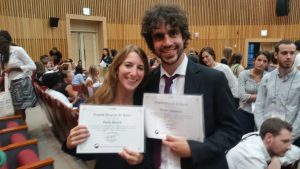
Americans were the majority of the new EPIK teachers. There were a handful of Brits, some Aussies, even less South Africans and maybe one Irish person. All in all, Americans were the largest nationality and because of this, we found ourselves whooping at every occasion, we loved everything and we started changing our accent! We even whooped and clapped the Dean of the University for instance. In the UK, a solemn clap would be more than enough.
The positivity and the openness to chat to everyone was exactly what was needed for this occasion though and meant meals in the university cafeteria had an edge of excitement. Not only because of the array of different Korean foods and Western dishes that were served at each sitting but also because you never knew who you might plonk down next to and what conversation might occur. Often it was about teaching, where you were from, how you were finding the week but occasionally, you’d hit on an in-depth conversation about politics, history or cultural differences between countries.
I was happy to find that other couples our age had taken this journey as well which made me feel less abnormal as I had done before I’d left the UK. Quitting your career at 28 and moving to South Korea to teach English went somewhat against everyone’s expectations and views of what we should/should not be doing at this stage of life. Nonetheless, here I was in a South Korean University (Busan University of Foreign Languages) trying fit in with lots of excited graduates much younger than myself!
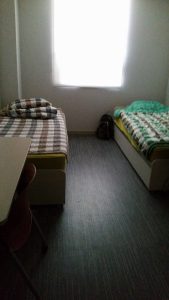 Everyone shared a room with a roommate. Girls and boys were not allowed to share a room or even visit each other’s dorms, which was a struggle for my boyfriend and I who had one suitcase between us. I shared with a girl who was friendly, down-to-earth and liked to take time to watch movies in the dark in her room at night. This made it easy for me as I knew when I got back to the room, it would be bed time and I wouldn’t be woken up later.
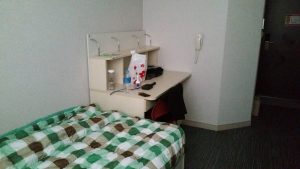
No alcohol was allowed in dorms and there was a curfew at 12. These rules were fine for me for one week but I don’t know how the Korean university students coped! It was difficult not sleeping with my boyfriend each night as we were used to. I had been particularly worried about this. It meant we wouldn’t get much time to ourselves to touch base and check we were coping. As it was, we did get some time alone in the evenings if we wanted it. We were also in classes together so we spent a lot of time together throughout the day.
The best meals at orientation were the ‘Welcome Dinner’, the ‘Farewell Dinner’ and the dinner we had out in a Korean restaurant half way through the week. The latter being a ‘Galbi’ dinner where chicken ribs are cooked into a stew with mushrooms, fish cakes and sausages on a communal frying pan and the other dinners being a huge array of sushi, meat and puddings in the cafeteria. By the end of orientation, our chopstick skills, our social skills and our knowledge of America had increased substantially. As had, of course, our knowledge of teaching English to Korean students.
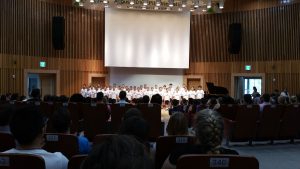
We had had a series of seminars and lectures throughout the week on a variation of subjects from ‘Co-Teaching’ and ‘Storytelling’ to ‘Life in Korea’ and Korean language lessons. I learnt more Korean in those 3 lessons than in months in England, amazing the difference motivation can make! At the end of the week we had to do a 15-minute lesson to the group with a partner. This was the cause of much consternation, anxiety and gossip among the whole cohort. Even so, at the end of the week, the lessons were presented and some informal, generally good feedback was received. Everyone looked towards the real challenge that lay ahead. Teaching every day and moving into our new cities.
Orientation certainly prepared us for what lay ahead in terms of teaching, co-teaching and life in Korea. It also gave us a solid group of friends that are still with us now and have been instrumental in our enjoyment of going out and getting to know the place. I hope that these friends will be lasting ones. What orientation did not prepare us for was the level of isolation that can be felt as the only native teacher in a school, the regularity of random octopus tentacle in all meals (even in meat dishes) and the inexhaustible generosity and friendliness of the Korean public.